


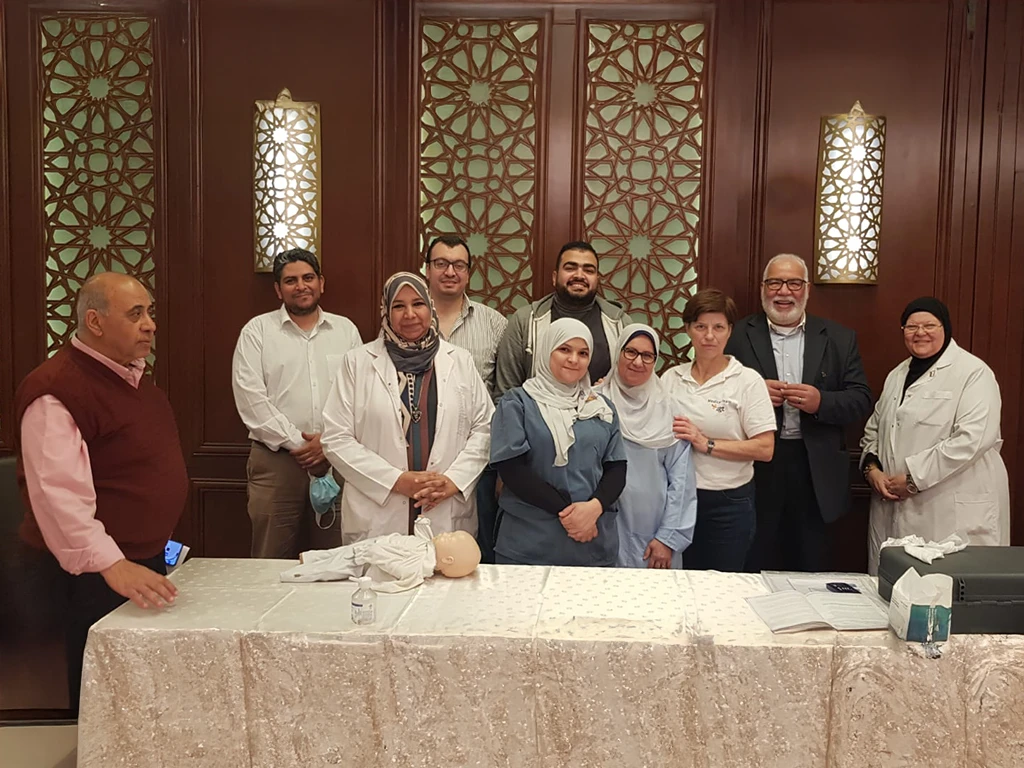
During the first week of April, an intensive Basic Life Support (BLS) training week for healthcare professionals took place in Cairo and the surrounding area. This week focused entirely on strengthening practical resuscitation skills. The training sessions were organized in accordance with the guidelines of the European Resuscitation Council (ERC). Because Egypt is a full member of the ERC, BLS skills are part of the mandatory basic training for nurses and physicians.
Over six days of training, more than 150 healthcare providers participated in the program. Many participants already demonstrated a good understanding of the theoretical frameworks, but practical exercises are often less common in daily practice. This makes these training sessions particularly valuable: extensive practice builds confidence and demonstrates the importance of repeating procedures regularly.
De behoefte aan aanvullende praktijktraining werd al snel zichtbaar. Na de BLS-sessies wilden veel deelnemers ook aan de slag met Pediatric Basic Life Support (PBLS). Vooral het oefenen van handelingen rondom verstikking bij baby’s werd als belangrijk en leerzaam ervaren. De motivatie binnen de groepen was groot; deelnemers stelden veel vragen, oefenden intensief en gaven aan dat zij de praktische aanpak erg waarderen.
The training days were intensive, but the dedication and commitment created a positive learning environment. It was clear that the healthcare professionals are eager to invest in their skills, especially because acute situations can arise quickly and unexpectedly. By continuing to practice, healthcare becomes safer and staff are more likely to act effectively in crucial moments.
Donation of exercise equipment to hospitals
To ensure hospitals can continue practicing after this training week, a BLS training manikin and a PBLS training manikin were donated to two regional institutions at the end of the program. This training equipment allows for skills review, new staff training, and structured attention to resuscitation instruction.
This donation is an important step towards sustainable knowledge transfer. It enables hospitals to independently improve the quality of their acute care, so that more healthcare providers are prepared for emergencies.


Samenwerking ter plaatse
During the training week, good collaboration with local partners was essential. Translation support played a key role in making the lessons accessible. Transportation between the various locations also ran smoothly thanks to local support, which is certainly not a given in a busy city like Cairo.
The combination of language support, logistical assistance and the involvement of local healthcare professionals made this week an effective and well-organized event.
Looking back
The training week in Egypt demonstrates the value of practical training, especially in healthcare systems where there is less time and resources available for regular practice sessions. By supporting healthcare professionals both theoretically and practically, the foundation is laid for better acute care and increased trust in the workplace.
This experience underscores the importance of international collaboration in education and knowledge exchange. Relatively simple tools—such as practical training and the provision of practice materials—can make a lasting difference in the quality of care.
The commitment and motivation of all involved make it clear that these kinds of initiatives are not only useful, but also necessary for strengthening healthcare worldwide.
Gerdie Rouwmaat